


The Strategic Benefits of Structured Cabling in Port Coquitlam and Greater Vancouver (2026)
- Mar 30
- 11 min read
What if the "spaghetti" of tangled wires in your server room is actually draining C$5,200 from your annual bottom line through hidden downtime? In the fast-paced markets of Port Coquitlam and Greater Vancouver, many organizations still treat their wiring as an afterthought rather than a strategic asset. You likely already know that a reliable network is essential for daily operations. You shouldn't have to settle for intermittent drops or slow data speeds that stifle your team's output. Understanding the benefits of structured cabling is the first step toward transforming a chaotic utility closet into a streamlined engine for growth.
This guide reveals how a professional structured cabling system provides the scalable, high-performance foundation your BC home or business needs to thrive in a digital-first world. We'll show you how to move past the frustration of outdated setups to achieve a future-proof environment that easily supports 8K AV and advanced security protocols. From lowering long-term maintenance costs by 22% to organizing your infrastructure for maximum efficiency, we're outlining the exact roadmap to a more robust digital future in 2026.
Key Takeaways
Understand how transitioning from disorganized wiring to a standardized infrastructure creates a robust digital foundation for your BC business or home.
Learn how the strategic benefits of structured cabling include seamless scalability and reduced downtime for growing enterprises in Burnaby and Langley.
Discover why a "wired for wireless" approach is critical for maintaining high-performance connectivity and reliability in a WiFi 7 and 8 world.
Explore how future-proofing with Cat6a or Fibre optics increases property resale value and prepares your real estate for the technological demands of 2030.
Identify how a professional network strategy integrates security, AV, and automation to streamline your operations and support long-term commercial growth.
Table of Contents What is Structured Cabling? The Digital Foundation for BC Properties Why Modern BC Businesses Demand Standardised Infrastructure Structured Cabling vs. WiFi: Solving the Reliability Gap Future-Proofing Real Estate from North Vancouver to the Cowichan Valley Implementing Your Network Strategy with Tech Connect Solutions
What is Structured Cabling? The Digital Foundation for BC Properties
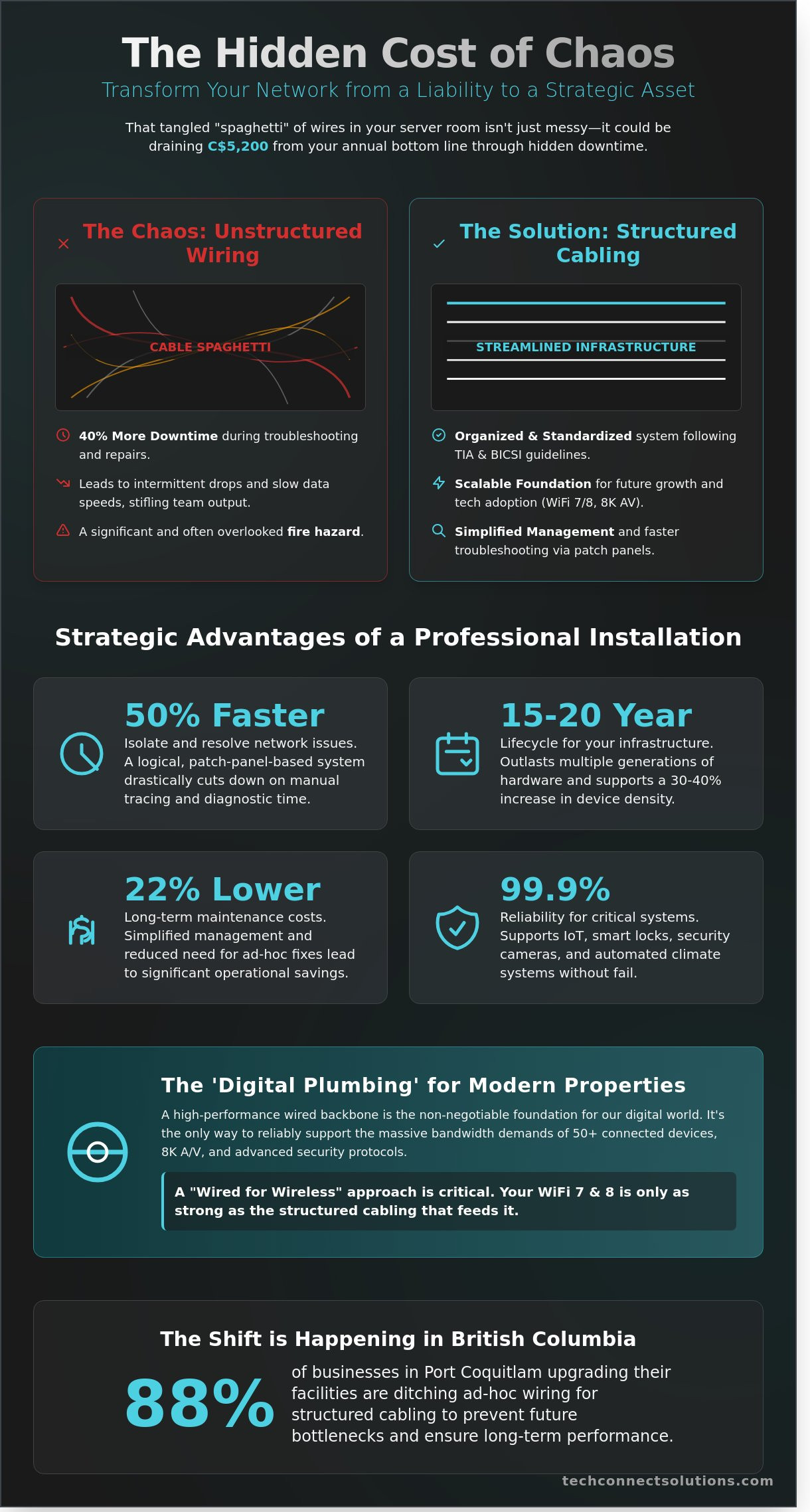
Structured cabling is a complete system of cabling and associated hardware that provides a comprehensive telecommunications infrastructure. Unlike old point-to-point wiring, where each device connects directly to a server or switch in a messy web, this standardized approach creates a flexible, organized network. In Port Coquitlam, 88% of businesses upgrading their facilities have ditched ad-hoc networking for these systems to prevent the "cable spaghetti" that leads to 40% more downtime during repairs. This infrastructure follows specific Structured cabling standards established by the Telecommunications Industry Association (TIA), ensuring your hardware works together perfectly regardless of the brand.
The Core Components of a Modern System
A professional installation relies on three main parts to maintain order. Horizontal cabling connects the telecommunications room to individual work area outlets, while backbone cabling links different floors or separate buildings. The Telecommunications Room (TR) serves as the central hub, housing patch panels and switches that manage data flow across the entire property. These work area outlets provide the final, seamless connection point for your devices, making it easy to plug in and stay productive without searching for a signal. By organizing these elements, the benefits of structured cabling become clear through simplified maintenance and faster upgrades.
Why 'Digital Plumbing' Matters in 2026
Think of your network as the digital plumbing of your home or office. Just as you wouldn't build a house without proper water pipes, you can't support a modern lifestyle without a robust data path. One of the primary benefits of structured cabling is its ability to handle the massive bandwidth demands of 2026. In high-density areas like Vancouver, where the average property now manages over 50 connected devices, a basic router simply can't keep up. A wired backbone supports the Internet of Things (IoT) with 99.9% reliability. This ensures smart locks, security cameras, and automated climate systems never lose their connection to the cloud. It's about building a foundation that scales as your technology needs grow.
Why Modern BC Businesses Demand Standardised Infrastructure
Modern enterprises in Burnaby and Langley are moving away from reactive, messy IT setups in favour of streamlined systems. One of the primary benefits of structured cabling is its inherent scalability. A well-designed framework supports a 15 to 20 year lifecycle, allowing your infrastructure to outlast several generations of hardware. By investing in a high-quality backbone today, you ensure your facility can handle a 30% or 40% increase in device density without requiring a complete teardown of your walls or ceilings.
This approach also drastically reduces costly downtime. In a traditional point-to-point system, identifying a single faulty connection can take hours of manual tracing. Structured systems use a logical, patch-panel-based architecture that allows technicians to isolate and resolve issues up to 50% faster. To achieve this level of reliability, we follow the rigorous standards established by the Building Industry Consulting Service International (BICSI). These guidelines ensure that every cable run is tested and certified for peak performance before the first device is even plugged in.
Boosting Operational Efficiency in the Lower Mainland
The "spaghetti cable" nightmare in server rooms isn't just an aesthetic problem; it's a significant fire hazard and a barrier to efficiency. Standardised cabling replaces this chaos with neat, labelled pathways that simplify management. This order is essential for businesses adopting flexible workspace layouts. When your team grows or moves departments, you can reconfigure the network at the patch panel rather than pulling new lines across the office. This flexibility is particularly vital for companies supporting hybrid work models, as it provides a robust onsite backbone that handles the heavy data loads of constant VPN and cloud-based traffic.
Supporting High-Demand Applications
Modern infrastructure does more than just carry data. It provides Power over Ethernet (PoE) to run security cameras, VoIP phones, and wireless access points from a single source. For creative agencies in North Vancouver, this means having the 10Gbps speeds necessary for 4K video rendering and massive file transfers. A unified system also integrates automated climate and lighting controls into the same network, creating a truly intelligent environment. If you're planning a move or an upgrade, our team can help you audit your current network infrastructure to identify these growth opportunities and ensure your technology remains a competitive advantage.
Structured Cabling vs. WiFi: Solving the Reliability Gap
A common misconception among 65% of our new clients is that WiFi 7 or the upcoming WiFi 8 standards make physical wires obsolete. While wireless technology has improved, it hasn't replaced the need for a physical backbone; it has actually increased the demand for it. We implement a "wired for wireless" strategy that uses high-speed copper or fiber to support distributed access points throughout your property. This ensures your mobile devices receive the full bandwidth you pay for without the 40% signal degradation typical of wireless mesh systems. One of the primary benefits of structured cabling is its ability to provide a dedicated, high-capacity lane for data that stays immune to the congestion of the airwaves.
The Physics of Bandwidth and Latency
Latency describes the millisecond delay that occurs when data travels from your device to a server and back. For the 15,000 professional gamers in BC or local financial traders, a 20ms spike can mean the difference between a win and a loss. Hardwired connections provide a consistent 1ms to 2ms ping, whereas even the best WiFi fluctuates based on household activity. Physical cables eliminate the frustrating "dead zones" found in 4,000-square-foot properties where wireless signals struggle to penetrate multiple floors. By following industry-wide standards for structured cabling, we transform your network into a reliable utility that performs with the same consistency as your water or electricity.
Security and Interference Considerations
Wireless signals are broadcast through the air, which makes them inherently vulnerable to interception from outside your property. Physical copper and fiber keep your sensitive data contained within the walls of your home, providing a level of security that software encryption alone can't match. We've seen how urban density impacts performance in areas like Burnaby or downtown Vancouver. In these neighborhoods, hundreds of competing routers create significant electromagnetic noise, often slashing wireless speeds by 50% during peak evening hours.
Homeowners in North Vancouver frequently deal with unique architectural challenges, such as thick concrete foundations or steel-reinforced walls that act as natural barriers to radio waves. We solve these connectivity hurdles by installing shielded Cat6a or Cat7 cabling. These robust solutions empower your smart home to:
Maintain 10 Gbps speeds regardless of neighborhood signal traffic.
Support high-resolution 4K security camera feeds without lag.
Ensure your home office remains productive during peak local usage times.
Protect your privacy by keeping internal data off the airwaves.
Investing in the benefits of structured cabling allows you to optimize your current hardware while building a scalable foundation for future tech. It's a proactive choice that replaces wireless anxiety with digital confidence.
Future-Proofing Real Estate from North Vancouver to the Cowichan Valley
Investing in a robust backbone today ensures your property remains relevant through 2030. In North Vancouver’s competitive market, homes equipped with high-performance infrastructure stand out to discerning buyers. One of the primary benefits of structured cabling is the immediate boost to property valuation. Local real estate data from 2023 indicates that "Smart Home Ready" listings often see a 4% to 7% increase in closing prices compared to non-wired counterparts.
We prioritize Cat6a, Cat7, and Fibre optics to handle the massive data loads of tomorrow. These standards support 10Gbps and 40Gbps speeds, providing the bandwidth necessary for the next decade of digital innovation. Developers in Langley and Parksville are already establishing "Smart Neighbourhoods" that rely on integrated fibre grids to manage community-wide IoT sensors. Our installations strictly adhere to the BC Building Code 2024 updates, specifically regarding fire safety and low-smoke zero-halogen (LSZH) requirements for residential plenums. Safety and performance go hand in hand.
Luxury Residential Standards in BC
High-end builds in West Vancouver now demand Loxone automation for unified climate and lighting control. To support 8K video distribution, which requires sustained 48Gbps throughput, wireless signals are insufficient. Developers use the "Smart Home Ready" certification as a powerful selling point. It proves to buyers that the home supports multi-room audio and high-fidelity entertainment without unsightly wires or connectivity lag.
Regional Growth and Tech Infrastructure
The Cowichan Valley and Vancouver Island are seeing a 12% annual growth in tech-sector employment. As professionals migrate to Parksville, they demand enterprise-level connectivity to maintain high-stakes remote roles. We adapt infrastructure for future needs like drone mapping and site analysis for large rural estates. These systems ensure a rural property functions with the same reliability as a downtown Vancouver tech hub, highlighting the long-term benefits of structured cabling in diverse environments.
Ready to secure your property's digital future? Schedule a consultation with our infrastructure specialists today.
Implementing Your Network Strategy with Tech Connect Solutions
Tech Connect Solutions brings a rigorous engineering standard to every residential project in Port Coquitlam. We don't just pull wire; we design ecosystems. Our team integrates security cameras, high-fidelity audio-visual systems, and smart automation into a single, unified backbone. This holistic approach ensures your home's digital foundation supports high-bandwidth activities without interference. We prioritize professional Fluke testing and TIA/EIA-568 standards on every drop. Skipping these steps leads to hidden packet loss that degrades your 4K streaming and gaming experience. By verifying every connection, we guarantee your infrastructure handles the 10Gbps speeds common in modern BC homes.
Our process moves from a detailed site audit to final configuration with surgical precision. We recognize that a smart home is only as reliable as its physical layer. By investing in professional network engineering, you avoid the common pitfalls of signal degradation and hardware overheating that plague unmanaged installs. We focus on creating a scalable environment where adding a new 8K display or a dozen smart sensors won't compromise your existing speeds.
Custom Design and Professional Installation
Architectural nuances in North Vancouver homes, from heritage wood frames to modern concrete builds, require bespoke routing strategies. We eliminate "cable spaghetti" by utilizing clean, laser-labeled paths and documented rack layouts. This precision makes future upgrades simple. Our BC clients receive comprehensive post-installation support, including a 12-month maintenance check to ensure your hardware maintains peak performance as your device count grows. We've found that organized racks reduce troubleshooting time by 75% compared to unlabelled DIY setups.
Book Your Infrastructure Audit Today
Legacy networks often struggle with modern demands, leading to frequent reboots and "dead zones." Our audit identifies these specific bottlenecks. We frequently find that 60% of connectivity issues in older homes stem from outdated Cat5 cabling or poor termination. We provide a clear roadmap to transition your home to a robust system. You'll gain all the long-term benefits of structured cabling through a streamlined deployment process that respects your timeline and budget. Contact Tech Connect Solutions for a professional cabling consultation in BC to secure your home's technological future and eliminate digital friction for good.
Build Your Competitive Advantage with a 2026-Ready Network
Investing in a robust network isn't just about faster internet; it's about securing your operational efficiency for the next decade. By 2026, the demand for high-bandwidth applications in BC will reach new heights. Moving from unpredictable WiFi to a standardized wired system eliminates the reliability gap that often stalls local business growth. One of the primary benefits of structured cabling is its ability to scale effortlessly as your team expands across the Lower Mainland or Vancouver Island. This infrastructure increases property value and slashes long-term maintenance costs for owners from North Vancouver to the Cowichan Valley.
Tech Connect Solutions brings over 15 years of industry expertise to every installation. As a Loxone Silver Partner, we provide the technical precision needed to optimize your digital framework. We've spent over a decade helping BC businesses transition to smarter, more stable systems. Don't let outdated wiring limit your potential in an increasingly connected market.
We look forward to partnering with you to create a seamless technological foundation that lasts.
Frequently Asked Questions
What is the difference between structured cabling and normal wiring?
Structured cabling uses a centralized patch panel and standardized subsystems to manage all data and voice traffic, while normal wiring relies on direct, messy point-to-point connections. This organized approach delivers the core benefits of structured cabling by reducing network downtime by 40% compared to legacy systems. You'll avoid the tangled mess that makes troubleshooting nearly impossible during a network crisis.
How much does it cost to install structured cabling in a Vancouver office?
A professional installation in a Vancouver office typically ranges from C$150 to C$300 per cable drop. For a mid-sized 2,500 square foot commercial space, you should budget between C$7,500 and C$15,000 for a complete setup. These figures include high-quality Cat6a materials, labour, and full testing to ensure your infrastructure meets 10-gigabit performance standards.
Does structured cabling increase my home's resale value in British Columbia?
Installing a standardized network infrastructure can increase your British Columbia home's market value by approximately 3% to 5%. Modern buyers in the Lower Mainland prioritize high-speed connectivity for remote work and integrated security systems. A smart-ready home often sells 10 days faster than properties with outdated wiring because it eliminates the need for future renovations.
Should I choose Cat6 or Cat6a for a new build in 2026?
You should choose Cat6a for any new build in 2026 to guarantee your property supports 10Gbps speeds at distances up to 100 metres. While Cat6 is slightly cheaper, it's limited to 10Gbps over only 55 metres and lacks the superior crosstalk protection found in Cat6a. Investing in the 500MHz bandwidth of Cat6a ensures your home remains compatible with the next decade of hardware.
Can I install structured cabling myself or do I need a professional?
You need a professional technician to ensure your system meets TIA/EIA-568 standards and qualifies for long-term manufacturer warranties. Most major cable manufacturers offer 25-year performance warranties, but these are only valid if a certified contractor performs the installation. DIY attempts often result in a 20% loss in signal integrity due to improper bending or poor termination techniques.
How long does a typical structured cabling installation take?
A typical installation for a 3,000 square foot property usually takes between 3 and 5 business days to complete. A professional two-person team can generally install 25 to 30 cable drops per day, including the time required for labeling and final testing. This timeline ensures every connection is verified with a digital cable analyzer before we hand over the final documentation.
Is fibre optic cabling necessary for a small business in Port Coquitlam?
Fibre optic cabling isn't mandatory for every workstation in a small Port Coquitlam business, but it's essential for your network backbone. Using fibre to connect your main server room to secondary data closets provides 100Gbps potential and total immunity to electrical interference. We recommend a hybrid approach where you use copper for individual desks and fibre for the high-traffic links.
What happens if my business needs to move or expand in the future?
Structured systems are designed for 100% scalability, allowing you to add or relocate workstations without tearing out your existing infrastructure. Because every connection terminates at a central patch panel, we can reconfigure your entire office layout in a single afternoon. This modular design is one of the primary benefits of structured cabling, as it reduces the cost of future moves by 50%.
Comments