


Scaling Your Business Network in Vancouver & BC: The 2026 Infrastructure Guide
What if the very growth you worked so hard to achieve across the Lower Mainland is the specific bottleneck currently strangling your daily operations? You likely recognize that scaling business network infrastructure requires more than just adding more bandwidth to a single router. It's frustrating when your Victoria satellite office loses sync with Vancouver during the 2:00 PM peak, or when security vulnerabilities in your remote access protocols create unnecessary risks. You deserve a system that remains stable as you expand from a single office to a province-wide enterprise.
We are here to ensure your technology empowers that expansion rather than hindering it. This guide provides a clear roadmap to evolve your digital infrastructure into a robust, multi-site operation that is ready for 2026 standards today. We will examine how to eliminate lag between Island and Mainland offices, implement enterprise-grade access control for hybrid teams, and select the right infrastructure strategies that account for the unique geography of British Columbia.
Key Takeaways
Move beyond simple bandwidth upgrades by understanding how scaling business network infrastructure requires a proactive approach to security and multi-site reliability.
Identify why structured cabling serves as the essential nervous system of your office and how to choose between Cat 6a and Fiber Optic for high-performance North Vancouver operations.
Evaluate the performance benefits of On-Premise, Cloud, and Hybrid models, specifically how local BC servers can eliminate latency for Vancouver-based media firms.
Follow a strategic 24-month roadmap to audit your current assets and accurately forecast device capacity for your next phase of expansion.
Discover how partnering with a local engineering team with over 15 years of experience in the Lower Mainland ensures your infrastructure supports your long-term commercial goals.
Table of Contents Beyond Bandwidth: What Scaling a Business Network Means in 2026 The Physical Foundation: Structured Cabling and Hardware Readiness Strategic Architecture: Comparing Network Models for BC Enterprises A Step-by-Step Roadmap for Expanding Your Network Infrastructure Partnering for Growth: Professional Network Engineering in the Lower Mainland
Beyond Bandwidth: What Scaling a Business Network Means in 2026
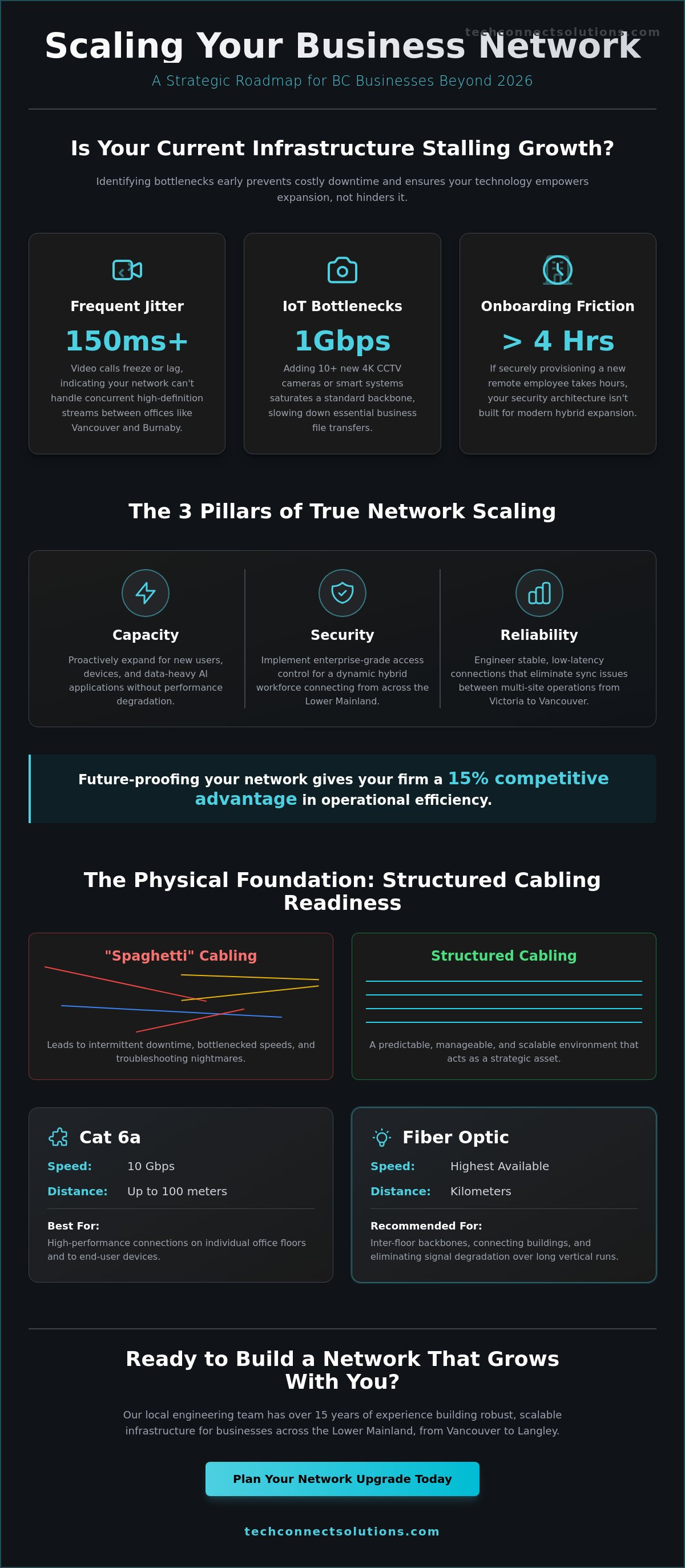
The shift toward hybrid work in Vancouver has fundamentally altered local area networks (LAN). Your office is no longer a self-contained bubble. It's a hub connecting to dozens of residential nodes across the Lower Mainland. This requires a shift from static setups to dynamic, software-defined environments that prioritize traffic based on urgency rather than just volume. Network future-proofing gives your firm a 15% competitive advantage in operational efficiency, according to 2025 industry benchmarks, by eliminating technical debt before it accumulates.
Signs Your Current Infrastructure is Stalling Growth
Identifying bottlenecks early prevents costly downtime. Look for these specific indicators that your current setup is reaching its limit:
Frequent Jitter: Video calls in Burnaby head offices experiencing 150ms delays or "frozen" screens indicate that your LAN cannot handle concurrent high-definition streams.
IoT Bottlenecks: Adding 10 new 4K CCTV cameras or smart lighting systems can saturate a standard 1Gbps backbone, slowing down essential file transfers.
Onboarding Friction: If it takes more than 4 hours to securely provision a new employee in a remote Cowichan Valley location, your security architecture isn't built for modern expansion.
The 2026 BC Business Tech Landscape
Local companies are rapidly adopting AI-driven tools that require massive internal data transfers. This isn't just a Vancouver trend. Port Coquitlam and Langley saw a 12% increase in tech-sector commercial leases in late 2025, signaling a shift toward regional tech hubs that require enterprise-grade connectivity outside the downtown core. By prioritizing the scaling business network process early, you ensure that your hardware doesn't become a bottleneck for these emerging AI applications.
Scalable Infrastructure is the bridge between current operations and 5-year growth goals.
We see a clear trend where businesses that invest in modular hardware today avoid the total "rip-and-replace" cycles that drain capital budgets. Your growth in the BC market depends on a foundation that expands as quickly as your client list does. We focus on building that foundation through precision engineering and a deep understanding of the local digital environment.
The Physical Foundation: Structured Cabling and Hardware Readiness
Your physical infrastructure acts as the nervous system of your entire operation. When scaling business network capabilities, many owners focus on software while ignoring the copper and fiber behind the walls. A weak physical foundation leads to intermittent downtime and bottlenecked speeds that no amount of high-end software can fix. We view professional cabling not as a utility, but as a strategic asset that supports every digital interaction your team makes.
Why Structured Cabling is Non-Negotiable
Implementing structured cabling prevents the chaotic "spaghetti mess" that often develops in server rooms. This organized approach uses a series of patch panels and trunk cables to create a predictable, manageable environment. For multi-floor offices in North Vancouver, the choice between Cat 6a and Fiber Optic is critical. While Cat 6a supports 10Gbps speeds up to 100 meters, we recommend Fiber Optic backbones to connect different floors. This eliminates the signal degradation common in vertical runs.
Precision matters in industrial zones like Langley, where heavy machinery generates significant electromagnetic interference. Professional engineering ensures your data lines are shielded and routed away from high-voltage sources to maintain zero signal interference. By utilizing industry-standard network components, you ensure that your physical layer remains compatible with future hardware upgrades for the next decade.
Hardware That Grows With You
Scaling requires a shift from unmanaged switches to managed solutions. Managed switches allow our team to segment your traffic, prioritize video conferencing, and isolate guest Wi-Fi for better security. This granular control is vital as your headcount increases. We also prioritize Power over Ethernet (PoE) technology. PoE allows you to power VoIP phones, wireless access points, and security cameras directly through the data cable. This eliminates the need for C$150 to C$250 electrical drops for every new device you add to the office.
Redundancy: BC's weather can be unpredictable. We integrate UPS systems and redundant power supplies to keep your core hardware online during localized outages.
Modularity: Rack-mounted solutions allow you to slide in new modules as you grow, rather than replacing entire units.
Active Cooling: Proper rack management includes dedicated airflow to prevent hardware throttling during peak usage.
Investing in higher-grade hardware during your initial fit-out saves significant capital later. It's much cheaper to install extra capacity now than to reopen ceilings in two years. If you're unsure if your current setup can handle your growth projections, let's discuss a site audit to map out your path forward.
Strategic Architecture: Comparing Network Models for BC Enterprises
Choosing the right framework is the first step when scaling business network capabilities across British Columbia. Enterprises must evaluate three primary architectures to find their ideal fit. On-premise models offer total control over data sovereignty, which is essential for legal and financial firms in Vancouver. Cloud-only models provide rapid deployment but can lead to unpredictable monthly costs as data egress fees climb. Hybrid models bridge this gap, offering a balanced approach for growing teams that need both power and flexibility.
For Vancouver-based media production houses, local servers provide a critical latency advantage. Processing 8K video files requires ultra-low response times that cloud providers often can't match. Keeping high-traffic data on-site reduces lag to under 5ms, ensuring creative workflows remain uninterrupted. To connect a Parksville branch office to a Vancouver HQ, we implement SD-WAN technology. This software-defined approach optimizes standard internet connections to create a secure, prioritized tunnel. It ensures your remote staff in the mid-island experience the same application performance as the head office without the high cost of private MPLS circuits.
The most common objection to a strategic approach to scaling business network infrastructure involves the perceived cost of professional engineering. While the initial design phase requires an investment, the cost of a network outage for a mid-sized BC firm can exceed C$7,500 per hour in lost productivity. Professional architecture isn't just an expense; it's a preventative measure that ensures your technology supports your revenue goals rather than hindering them.
The Hybrid Advantage for Mid-Sized Businesses
The hybrid model is the "sweet spot" for many BC companies. It allows you to keep mission-critical databases local for speed and security while using the cloud for collaborative tools like Microsoft 365 or Slack. To maintain a stable hybrid environment, your office requires specific hardware upgrades:
Layer 3 Managed Switches: These handle internal routing to keep local traffic off your main firewall.
Enterprise-Grade NAS: High-capacity storage units provide fast local access to large files.
Redundant ISP Links: Using two different BC providers ensures the cloud portion of your hybrid setup never goes dark.
One multi-site firm in the Lower Mainland recently reduced their system downtime by 40% after migrating from an aging on-premise server to a managed hybrid environment designed by TechConnect Solutions.
Security Integration in the Scaling Process
Scaling your digital footprint must include a review of your physical and network security. As your office footprint grows, integrating CCTV and access control into your network management plan is vital. We use VLAN segmentation to keep your guest Wi-Fi completely separate from secure business data, preventing unauthorized access from the lobby or breakroom.
Your firewall throughput is another critical factor. A 1 Gbps fiber connection won't help your team if your older security appliance caps out at 250 Mbps during deep packet inspection. As you scale, we ensure your security hardware matches your bandwidth so protection never comes at the cost of performance.
A Step-by-Step Roadmap for Expanding Your Network Infrastructure
Scaling business network capacity in British Columbia requires a clinical approach to both hardware and logic. We start by identifying the "weakest link" in your current environment. In 2024, data indicated that 62% of network bottlenecks in Lower Mainland offices were caused by aging Cat5e cabling or unmanaged switches hidden in server closets. Your expansion strategy must forecast user count and device density for the next 24 months. If your team is projected to grow from 15 to 45 employees, design for 10Gbps readiness now. The labor cost to rewire a ceiling in 2026 will be significantly higher than the marginal cost of installing high-spec copper or fiber today.
Phase 1: The Professional Network Audit
We begin by utilizing comprehensive troubleshooting checklists to uncover hidden hardware failures that stifle performance. For large-scale operations, such as 40,000 square foot warehouses in Burnaby, we conduct RF heat-mapping. This process ensures signal penetration through heavy steel racking and mezzanine levels. We also evaluate the "Low Voltage" capacity of your building. Many older commercial spaces in BC lack the conduit space for modern fiber runs. Identifying these physical constraints early prevents project delays and ensures your scaling business network remains on budget.
Phase 2: Deployment and Testing
Successful expansion depends on a phased rollout that avoids downtime during peak business hours. We implement "burn-in" testing for all new switches and access points for at least 48 hours before full migration. This identifies hardware that might fail during its initial power-on cycle. Once the hardware is stable, we focus on the human element. Training your staff on new security protocols and access control interfaces typically reduces internal support tickets by 35% during the first month of operation.
We finish the deployment by setting up automated alerts for proactive maintenance. These systems monitor traffic spikes and hardware health, allowing us to resolve issues before they impact your productivity. It's about creating a system that works for you, not the other way around. A robust infrastructure should be invisible to the end user while providing the power they need to succeed.
Ready to upgrade your infrastructure?
to start your professional audit today.
Partnering for Growth: Professional Network Engineering in the Lower Mainland
Tech Connect Solutions serves as the expert guide for BC organizations ready to move beyond legacy limitations. Scaling business network infrastructure requires more than just buying new hardware; it demands a partner who understands the local terrain. With 15 years of operational experience based in Port Coquitlam and Vancouver, we've helped local firms navigate the transition from small offices to multi-site enterprises. Our "Connection" philosophy treats infrastructure as the vital bridge between your commercial objectives and technical execution. We ensure every router, cable, and security sensor aligns with your 2026 growth targets.
Boutique Attention, Enterprise Expertise
Small and mid-sized teams often feel trapped between DIY IT solutions and massive, impersonal service providers. We bridge this gap by providing boutique-level attention backed by enterprise-grade expertise. Our team specializes in tailoring Loxone automation and advanced security protocols for scaling corporate environments. This integration allows you to control lighting, climate, and access through the same robust backbone that powers your data. Managing your cabling, networking, and physical security through a single partner eliminates the friction of multi-vendor troubleshooting. We are committed to the BC business community, providing consistent on-site support from the high-rises of Vancouver to the commercial hubs in Parksville.
Start Your Scaling Journey Today
A professionally engineered network provides a tangible return on investment by ending the cycle of reactive "emergency fixes." Reactive IT management is a drain on resources; it often results in unexpected downtime that disrupts workflows and damages client trust. Moving to a proactive model means your infrastructure anticipates demand before it becomes a bottleneck. When you focus on scaling business network capabilities now, you're investing in a foundation that supports high-bandwidth applications and remote collaboration for years to come.
Don't wait for a system failure to reveal the weaknesses in your current setup. Our team provides comprehensive site analysis and custom scaling strategies designed for the unique demands of the Pacific Northwest market. Take the first step toward a more resilient digital future. Schedule your 2026 network scaling consultation with Tech Connect Solutions to ensure your infrastructure is ready for what comes next.
Position Your BC Enterprise for 2026 and Beyond
Success in the modern BC landscape depends on a technical foundation that grows alongside your ambitions. You've learned that scaling business network infrastructure requires a transition from reactive fixes to a proactive architecture built on high-performance structured cabling. By following a structured roadmap, your organization avoids the common pitfalls of technical debt while staying ready for the automation demands of 2026. We've spent 15+ years refining our local BC integration expertise to ensure your hardware and software work in perfect harmony.
Tech Connect Solutions provides specialized Loxone automation and high-tier security integration for businesses throughout the Lower Mainland and Vancouver Island. We don't just install hardware; we build the bridges between your commercial objectives and technical execution. Our team focuses on creating efficient, robust systems that empower your staff and protect your assets. It's time to replace digital anxiety with the quiet confidence of a network designed for longevity.
Your path to a more efficient future starts with a single strategic choice. We're ready to help you lead the way in British Columbia's evolving digital economy.
Frequently Asked Questions
How do I know if my business network needs scaling or just a simple repair?
Persistent latency exceeding 100ms or bandwidth utilization consistently above 80% during peak hours signals a clear need for scaling. Simple repairs address localized hardware failures like a single faulty port; however, scaling solves systemic bottlenecks caused by adding new users or high-bandwidth applications. If your 2024 performance metrics show recurring slowdowns despite hardware resets, it's time to expand your infrastructure to support growth.
What is the cost difference between Cat 6 and Cat 6a for a BC office?
Cat 6a cabling typically carries a 20% to 30% price premium over Cat 6 due to increased material thickness and stricter installation requirements. While Cat 6 supports 10 Gbps up to 55 meters, Cat 6a maintains that speed across a full 100-meter run. Investing the extra capital now prevents the need for another full cable pull when 10-Gigabit speeds become the BC standard by 2028.
Can I scale my network without replacing all my existing hardware?
You can often scale your network through strategic modular upgrades rather than a total "rip and replace" approach. We focus on identifying specific bottlenecks, such as upgrading a core switch to a 10GbE model while retaining your existing Layer 2 edge switches. This phased strategy allows you to begin scaling business network capabilities while managing your capital expenditure effectively across the 2026 fiscal year.
How does structured cabling impact my business property value in Vancouver?
Modern structured cabling can increase commercial property valuations by 2% to 5% according to recent BC real estate industry benchmarks. Vancouver tenants in the tech and film sectors prioritize "Plug and Play" readiness, often signing leases 15% faster when a building features certified fiber backbones and organized IDF closets. High-quality infrastructure transforms a basic office into a Tier 1 digital asset that's ready for future demands.
What are the security risks of scaling a network too quickly?
Rapid expansion often creates "shadow IT" and overlooked entry points, increasing the attack surface by up to 40% if not managed correctly. New access points or subnets must be integrated into your existing firewall policies and VLAN structures immediately. Without a structured rollout, you risk leaving default credentials active or creating misconfigured ports that invite unauthorized access to your sensitive BC business data and client records.
How long does a typical professional network expansion take for a mid-sized office?
A professional network expansion for a 5,000 square foot Vancouver office typically requires 5 to 10 business days to complete. This timeline includes the initial site audit, cable pulling, hardware configuration, and final validation testing. We coordinate these phases during off-peak hours to ensure your daily operations continue without interruption, providing a seamless transition to your upgraded capacity without sacrificing productivity.
Is fiber optic internet necessary for every scaling business in British Columbia?
Fiber optic internet is essential for any BC business where more than 25% of operations rely on real-time cloud collaboration or large data transfers. While coaxial connections serve small retail footprints, fiber offers symmetrical upload and download speeds that are vital for scaling business network stability. If your 2026 roadmap includes VoIP, 4K video conferencing, or off-site backups, fiber is a non-negotiable requirement for success.
Comments