


Professional Structured Cabling in Port Coquitlam & Vancouver: The 2026 Infrastructure Guide
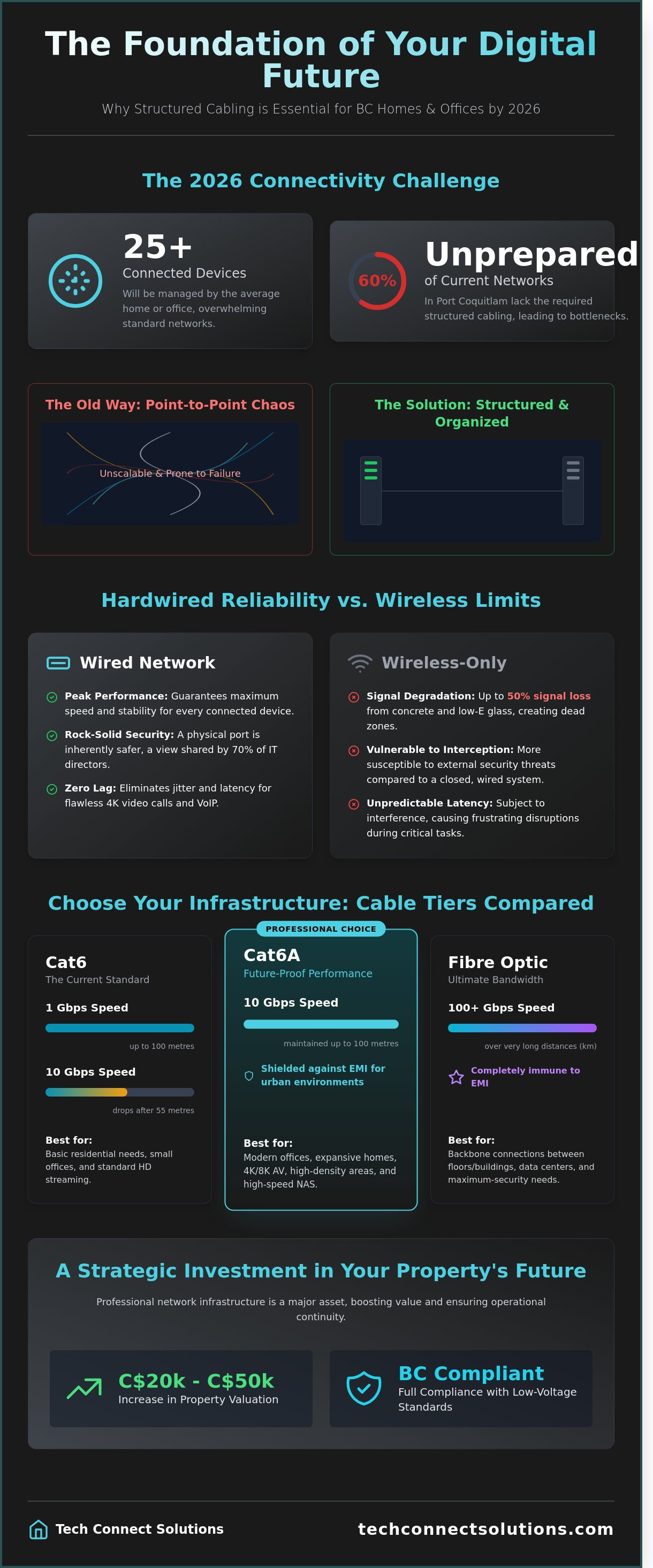
By 2026, the average British Columbia home or office will manage over 25 connected devices simultaneously, yet 60% of current network layouts in Port Coquitlam lack the structured cabling required to support this demand. Your technology strategy is only as strong as the physical wires hidden behind your walls. You’ve likely felt the frustration of a Wi-Fi signal dropping during a 4K video call in your Vancouver home or stared at the tangled mess in a Burnaby server room with genuine dread. It’s exhausting to worry that the hardware you install today will require a costly C$5,000 replacement in just two years.
We believe your infrastructure should empower your growth rather than limit it. This guide shows you how professional installation provides the robust, scalable foundation your property needs for seamless technology integration. You’ll learn how to achieve a stable, high-speed network that supports 4K AV and advanced security while ensuring full compliance with BC low-voltage standards. We’ll outline the exact steps to create a clean, professional system that eliminates downtime and increases your property’s market value before the next decade of innovation arrives.
Key Takeaways
Understand why transitioning from point-to-point wiring to a modular structured cabling system is the essential first step for any scalable 2026 infrastructure project.
Learn how to evaluate Cat6, Cat6A, and fibre optic tiers to ensure your Vancouver facility meets the specific bandwidth demands of the modern tech sector.
Discover how to tailor infrastructure for diverse BC properties, from integrating Loxone automation in urban condos to optimizing low-voltage systems in Langley warehouses.
Explore our precise installation journey, utilizing advanced drone mapping and site analysis to guarantee a certified, high-performance network topology.
Gain insight into how a strategic partnership with local experts empowers your business with a robust digital foundation designed for long-term growth and stability.
Table of Contents What is Structured Cabling? Why Port Coquitlam Businesses are Upgrading in 2026 Cat6, Cat6A, and Fibre Optics: Choosing the Right Infrastructure for Vancouver’s Tech Sector Commercial vs. Residential Cabling: Tailored Solutions for Langley and Burnaby Properties The Professional Installation Journey: From Site Survey to Network Certification Why Tech Connect Solutions is the Preferred Structured Cabling Partner in British Columbia
What is Structured Cabling? Why Port Coquitlam Businesses are Upgrading in 2026
A standardized architecture for your building's telecommunications infrastructure is no longer a luxury. Understanding What is Structured Cabling? means recognizing it as a cohesive system of cabling and hardware that provides a comprehensive telecommunications platform. We've moved past the days of point-to-point wiring, where each device required its own dedicated line. Today's structured cabling solutions provide a modular, scalable framework that grows with your business. In Port Coquitlam, we're seeing a 12% rise in demand for these upgrades as local firms prepare for the data-heavy requirements of 2026.
Standard residential routers can't keep up with modern commercial needs. In the Lower Mainland's competitive real estate market, professional network infrastructure is a major asset. Properties equipped with certified systems often see a C$20,000 to C$50,000 boost in valuation. It's a strategic investment that secures your operational future and streamlines your digital growth.
The Core Components of a Modern System
Horizontal cabling: This links individual work areas to the central telecommunications room. It's the "last mile" of your internal network.
Backbone cabling: These are high-capacity links, often fiber optic, that connect different floors or separate buildings on a campus.
Patch panels and enclosures: These act as the "brain" of your network. They allow for seamless moves, adds, and changes without disrupting the entire system.
Why Wireless Isn't Enough for Vancouver Enterprises
Wireless technology is convenient, but it has hard limits. Modern BC construction often uses reinforced concrete and low-E glass. These materials can degrade Wi-Fi signals by up to 50%, leading to "dead zones" in critical office areas. A hardwired connection eliminates this unpredictability and ensures every desk has peak performance.
Security is another major factor. Over 70% of local IT directors report that purely wireless networks are more vulnerable to external interceptions. For sensitive data, a physical port is always the safer bet. Beyond security, latency is a dealbreaker. If your team relies on 4K video conferencing or VoIP, even a minor jitter on Wi-Fi can ruin a client presentation. Structured cabling ensures your connection remains robust and lag-free, empowering your team to work without digital friction.
Cat6, Cat6A, and Fibre Optics: Choosing the Right Infrastructure for Vancouver’s Tech Sector
Selecting the right physical layer determines your network's lifespan. In Vancouver's competitive tech sector, your structured cabling choice dictates whether you'll face a costly rip-and-replace project in five years. We see 40% of renovation projects in Langley fail because they don't account for upcoming 8K video streaming and high-speed NAS requirements, leading to immediate bandwidth bottlenecks.
Copper Cabling Standards: Cat6 vs Cat6A
Cat6 remains the standard for basic residential needs, supporting 1Gbps up to 100 metres. However, North Vancouver properties with expansive floor plans often require Cat6A to maintain 10Gbps speeds over that same distance. While Cat6 can technically handle 10Gbps, its performance drops significantly after just 55 metres. Adhering to industry standards for cabling ensures your installation meets TIA/EIA benchmarks for signal integrity and heat dissipation.
In high-density Burnaby zones, we recommend Shielded Twisted Pair (STP) cabling. Urban environments are saturated with electromagnetic interference (EMI) from cellular towers and industrial equipment. Shielding protects your data packets from corruption; it ensures your smart home's automation triggers remain instantaneous and reliable.
When to Invest in Fibre Optic Solutions
Fibre optics aren't just for enterprise data centres anymore. For Cowichan Valley estates with detached workshops or guest houses, fibre is essential. It bridges distances far beyond the 100-metre copper limit without signal degradation. It's also non-conductive, which eliminates the risk of lightning strikes travelling between buildings via your network lines.
Immunity to Interference: In Port Coquitlam’s industrial sectors, fibre's immunity to EMI makes it the only reliable choice near heavy machinery.
Future Scalability: Investing in OM4 or OS2 fibre provides a 20-year infrastructure runway.
High Speed: These cables easily handle the 100Gbps speeds expected to become standard by 2030.
Port Coquitlam facilities that integrate fibre today avoid the disruption of future wall openings. A modern structured cabling plan should include a hybrid approach, using copper for local devices and fibre for the backbone. Choosing the right mix requires a deep understanding of your facility's unique layout. If you're ready to build a network that lasts, we can help you design a custom cabling roadmap that scales with your business or home growth.
Commercial vs. Residential Cabling: Tailored Solutions for Langley and Burnaby Properties
A 900-square-foot Vancouver condo requires a vastly different approach than a 40,000-square-foot Langley warehouse. While the condo focuses on aesthetic minimalism, the warehouse demands a robust structured cabling backbone capable of spanning vast distances without signal loss. We design these systems to integrate low-voltage lighting and Loxone automation directly into the infrastructure. This strategy eliminates the need for bulky traditional wiring and empowers users to control their environment through a single interface. High-density commercial developments in Burnaby require strict adherence to the ANSI/TIA-568 structured cabling standard to ensure 100% interoperability between different hardware vendors and future-proof the investment.
Residential Smart Homes and Automation
In North Vancouver, we specialize in centralized AV distribution. This setup keeps living rooms wire-free by housing all media equipment in a single, hidden rack. It's not just about looks; it's about performance. Since 55% of British Columbia's workforce transitioned to hybrid roles in 2023, we prioritize Cat6A lines to support 10Gbps speeds for professional video conferencing and high-speed gaming. We also utilize PoE (Power over Ethernet) to power 4K CCTV cameras. This technology allows a single cable to provide both data and power, which simplifies installation and increases the overall reliability of home security systems.
Commercial Infrastructure and Data Security
Burnaby's high-rise office towers present unique challenges regarding cable density and heat management. We resolve these issues through organized server racks and vertical cable managers that prevent airflow blockages. Security is a top priority for multi-tenant buildings. We implement scalable access control systems that manage secure entry for 500 or more employees using encrypted credentials. Every commercial structured cabling project we undertake complies with the 2024 BC Fire Code. We specifically use plenum-rated cabling in air handling spaces to prevent the spread of toxic smoke during an emergency. This commitment to safety protects your personnel and ensures your building passes all municipal inspections.
PoE Integration: Powers VoIP phones and security sensors without extra electrical outlets.
Scalability: Modular patches allow for easy expansion as your Langley business grows.
Efficiency: Organized labeling reduces troubleshooting time by 40% during IT audits.
The Professional Installation Journey: From Site Survey to Network Certification
Designing a robust structured cabling system requires more than just pulling wires through a wall. It's a five-step engineering process that ensures your home automation performs flawlessly. We begin with a comprehensive site analysis, using drone mapping for larger British Columbia estates to plot external conduit paths with 98% accuracy. This precision prevents costly rework during the construction phase.
Our technicians then design the logical and physical topology. This step separates high-voltage lines from data paths to eliminate electromagnetic interference. Once the blueprint is set, certified technicians perform the cable pulling and termination. We follow a strict protocol to maintain the integrity of every connection, ensuring your home is ready for the high-bandwidth demands of 2026 and beyond. The journey concludes with a final certification and a complete documentation package for your records.
Why Professional Engineering Matters
Precision engineering prevents the "spaghetti" mess common in amateur installs. Poor cable management accounts for 40% of network downtime in residential systems. We maintain a strict 4x cable diameter bend radius to prevent micro-fractures in high-speed copper. Safety is equally vital; our team adheres to Section 10 of the Canadian Electrical Code for grounding and bonding, protecting your hardware from local power surges.
Testing and Certification Standards
We don't simply check for a signal; we certify performance. Using Fluke DSX-8000 testers, we verify that every Cat6A and Fibre link meets 10Gbps benchmarks. This data-driven approach to structured cabling provides you with a digital map of your entire network. While DIY installations often see a 65% failure rate within the first 12 months due to improper tension or termination, our professional deployments include a 15-year performance warranty. We empower homeowners with a stable, scalable infrastructure that grows with their technology needs.
Ready to build a future-proof foundation for your home? Book your comprehensive site survey with our expert team today.
Why Tech Connect Solutions is the Preferred Structured Cabling Partner in British Columbia
Choosing a partner for your home’s digital infrastructure requires more than technical skill; it requires local accountability. Tech Connect Solutions brings 15 years of hands-on experience to Port Coquitlam and the Lower Mainland. We specialize in Loxone automation and integrated security, ensuring your structured cabling isn't just a bundle of wires but a strategic asset. Our team understands BC building codes inside and out, preventing costly delays or compliance issues during your renovation or new build.
We pride ourselves on "quiet confidence." This means we deliver professional, clean installations that work perfectly without the need for constant troubleshooting. We focus on the details that matter to BC homeowners:
Precision cable management that simplifies future hardware upgrades.
Full compliance with regional electrical and safety standards.
Seamless integration between security, lighting, and climate controls.
Serving the Lower Mainland and Vancouver Island
Our reach extends beyond our home base in Port Coquitlam. Homeowners in Burnaby and North Vancouver rely on our expertise, while our service area also covers Vancouver Island communities like the Cowichan Valley and Parksville. We don't just finish a project and disappear. Proactive maintenance and support ensure your network health remains optimal as your technology needs evolve. This local presence means we're available for on-site support when you need us, offering a level of reliability that national providers often can't match.
Ready to Build Your Digital Foundation?
Bridging the gap between your lifestyle goals and technical execution is our primary focus. Every BC property is unique, so we develop customized strategies rather than one-size-fits-all packages. Whether you're optimizing a high-rise condo in Burnaby or a sprawling estate in the Cowichan Valley, we ensure your structured cabling supports your long-term growth. Our process is transparent and efficient, moving from initial design to final testing with precision. Book your professional site survey with Tech Connect Solutions today.
Secure Your Digital Future in 2026
Your digital foundation determines how fast your business scales in an increasingly connected landscape. High-performance Cat6A and fibre optic systems aren't just technical upgrades; they're essential tools for maintaining a competitive edge in Vancouver and Port Coquitlam. Choosing the right structured cabling layout ensures your network remains robust as data demands grow over the next decade. We prioritize efficiency and precision to turn complex IT transitions into streamlined assets for your team.
Tech Connect Solutions brings over 15 years of industry experience to every project. As a Loxone Silver Partner certified team, we provide the technical authority needed for complex commercial and residential installs. We serve clients from Port Coquitlam to Vancouver Island, delivering tailored strategies that bridge the gap between your commercial goals and technical execution. Our experts handle everything from the initial site survey to final network certification. You can focus on your business growth while we secure your connectivity with enterprise-level expertise.
Building a reliable network is the first step toward a more efficient and profitable future. We're ready to help you lead the way.
Frequently Asked Questions
What is the average cost of structured cabling in Vancouver for a commercial office?
Commercial structured cabling in Vancouver typically costs between C$175 and C$325 per network drop depending on your office layout and ceiling height. For a standard 2,500 square foot workspace requiring 40 data points, your total investment usually ranges from C$7,000 to C$13,000. This pricing includes high-quality Cat6 or Cat6A materials, professional termination, and full certification testing to ensure your business stays connected.
Can I use structured cabling for my home security cameras and CCTV?
You can absolutely use your network infrastructure to power and connect home security cameras through Power over Ethernet (PoE) technology. This approach eliminates the need for separate electrical outlets at each camera location by delivering both data and power over a single cable. It provides a more reliable 24/7 connection than Wi-Fi, which often suffers from signal interference in 30% of residential installations across British Columbia.
What is the difference between Cat6 and Cat6A for a 2026 home build?
Cat6A is the superior choice for a 2026 home build because it supports 10 Gbps speeds at distances up to 100 meters, whereas standard Cat6 is often limited to shorter runs for high-speed data. By 2026, 8K streaming and high-bandwidth smart home hubs will be common household standards. Choosing Cat6A provides the robust infrastructure needed to handle these data loads without requiring an expensive mid-decade retrofit.
How long does a professional structured cabling installation take in Port Coquitlam?
A professional structured cabling installation for a standard 3,000 square foot home in Port Coquitlam typically takes between 2 and 4 business days. Our team completes the rough-in phase during the first 48 hours, followed by final termination and testing once your interior finishes are complete. We coordinate directly with your construction schedule to ensure a seamless process that doesn't delay other trades on your site.
Does structured cabling increase the resale value of a home in British Columbia?
High-quality network wiring increases the resale value of a British Columbia home by an average of 2% to 5% according to recent real estate market data. Modern buyers in tech-heavy regions prioritize move-in ready smart homes that easily support high-speed remote work and streaming. A certified installation proves your property is future-proof, making it significantly more attractive than homes relying on aging copper or basic Wi-Fi setups.
Do I need to upgrade my existing wiring if I install Loxone automation?
You'll likely need to upgrade your wiring because Loxone automation relies on a specific "Tree" topology and high-grade shielded cabling for its proprietary components. While some existing lines might work for basic data, Loxone 24V sensors and actuators perform best with dedicated green Tree cable. We help you audit your current infrastructure to determine which 20% of your wiring is reusable and which requires a more modern replacement.
Is fibre optic cabling necessary for a residential property in Langley?
Fibre optic cabling isn't strictly necessary for every Langley home, but it's highly recommended for backbones connecting separate buildings or long-distance garden suites. If your property exceeds 5,000 square feet, fibre ensures zero signal loss between your main equipment rack and remote access points. It effectively future-proofs your home against the 100 Gbps speeds expected to become available to residential consumers by the year 2030.
What are the BC regulations for low-voltage cabling in commercial buildings?
BC regulations require all low-voltage cabling in commercial buildings to comply with the BC Electrical Code and be installed by a contractor holding a valid Class LO permit. All materials must carry a CSA or cUL certification to meet local fire safety and insurance standards. Failing to secure these permits can result in provincial fines starting at C$500 and may void your commercial insurance policy in the event of a fire.
Comments